“There is no logical way to the discovery of these elemental laws. There is only the way of intuition, which is helped by a feeling for the order lying behind the appearance. “
—Albert Einstein, Where is Science Going, Introduction (1932)
In 2011 the now late Nobel laureate, Daniel Kahneman published Thinking Fast & Slow, which distilled his vast and highly-regarded body of research encompassing systematic thinking, behavioral decision-making, intuition and heuristics (a kind of mental “rules of thumb”). In it Kahneman described a two system model of mind and decision-making.
System 1 or System 2?

For Kahneman System 1 was fast, intuitive, emotional and instinctive, whereas System 2 was slower, more analytical and deliberate. We humans are designed to conserve energy, and seeing that System 2 was way more energy hungry than System 1, his proposition was that we would often default to instinct and heuristics to save gas. Equally, in the more urgent of our life circumstances, intuitive systems importantly save time.
To Kahneman, the downside of this intuitive system is that it is ineffably prone to error. We harbor cognitive biases, we can be subject to the effect known as to priming and we’re also prone to simple old Pollyanna-ish optimism and overconfidence. Considering this came from such an eminent mind, it would seem that attempting to consider intuition as a source for good decision-making—certainly intuition in coaching—might have stumbled right here at the first hurdle.
But perhaps we might not want to jump the gun!
An Alternative Emerges
For a fascinating counterpoint to Kahneman’s views, meet Gerd Gigerenzer. Gigerenzer is a director at the Berlin-based Max Planck Institute for Human Development and a Professor of Psychology at the University of Chicago. Considered a world class expert in risk, he laid out an alternative perspective on intuition’s role in effective decision-making. In a 2013 publication titled Risk Savvy Gigerenzer tells us
“An intuition is neither caprice nor a sixth sense but a form of unconscious intelligence.”
In fact, Gigerenzer’s even earlier book titled Gut Feelings: The Intelligence of the Unconscious offered a seemingly more nuanced if not alternative view of intuitive decision-making. There he declared that under certain conditions it was actually more reliable than logic and analysis. And what were those conditions?
- If all risk parameters are known, good decisions require logic and statistical thinking. (System 1)
- If there are unknown parameters, then good decisions also require intuition (and some smart rules of thumb.) (System 2 with a little test and verify)
Gladwell and Blink

Already we begin to see more subtlety in how we might employ these powerful systems for our best decisions. Under certain conditions intuition makes for the best decision-making. Though we also need a little of the logical system to weed out the unconscious biases and logical errors that the implicit (another term for unconscious) cognitive system can be prone to.
The power of intuition also formed the central theme in Malcolm Gladwell’s bestseller Blink:The Power of Thinking Without Thinking. There he overwhelmingly appeared to advocate for Gigerenzer’s view that the intuitive system is an incredibly powerful tool often capable of better decisions under certain circumstances.
“We really only trust conscious decision making. But there are moments, particularly in times of stress, when haste does not make waste, when our snap judgments and first impressions can offer a much better means of making sense of the world.”
Yet despite the neat binary logic of the two systems—the fast and frugal intuitive system 1 and the more reasoned and logical number 2—curiously it seems that only Gladwell appears to even hint at any other possibilities. Ones with considerable implications for employing intuition in coaching.
About Slow Intuition
What if intuitive intelligence doesn’t only present rapidly (the ‘blink’ type of knowing that Gladwell refers to as does Kahneman’s System 1)? What if there was a slower form of it as well? Perhaps one that given time, space and the appropriate conditions, might be far more effective and reliable, even overcoming those tricksy unconscious biases.
Well it seems it does and cognitive scientist Guy Claxton has spent considerable time exploring this possibility writing in Hare Brain Tortoise Mind: How Intelligence Increases When You Think Less that
“Recent scientific evidence shows convincingly that the more patient, less deliberate modes of mind are particularly suited to making sense of situations that are intricate, shadowy or ill-defined.”
Claxton outlines a compelling case for this mode he calls the slow intuitive and it now appears that this may be our most powerful asset for generating truly creative thinking. And as coaches are all about helping their clients to think generatively about themselves and their situations, it seems clear that this mode of intuition in coaching is worth paying attention to and developing.
Intuition and Creativity Theory
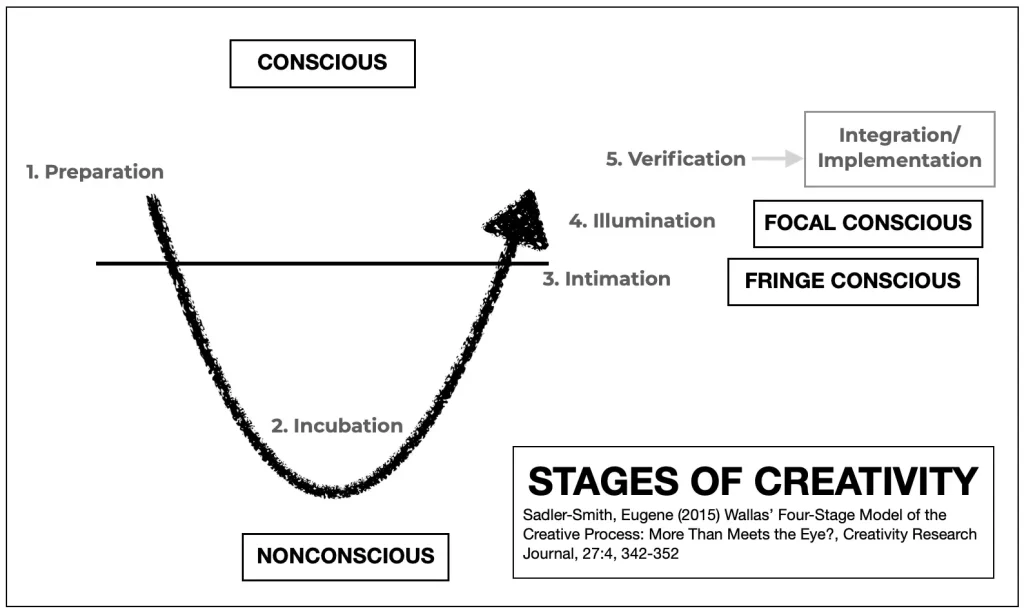
While there are many versions of Creativity Theory, the one that undoubtedly speaks to Claxton’s slow intuitive perspective is Graham Wallas’ four stage model (see image below). In this, following the first stage of Preparation (all the investigation and knowledge building) comes the phase of Incubation. Here one lets go of their logical thinking and analytic investigation and allows the deeper, slower cognitive processes to go to work. The very place of the slow intuitive. And then from here the thinking moves slowly upwards out of the murky, felt implicit zone into insight. These are those truly illuminated new perspectives that have the power to change the course of ones life and, in some cases highlighted by Wallas, the course of humanity itself!
Frequently Asked Questions: Intuition in coaching
What is the role of intuition in coaching?
In a coaching context, intuition acts as a form of unconscious intelligence. It allows a coach to sense patterns, shifts in energy, or “murky” felt senses that logic alone might miss. While traditional coaching relies on System 2 (analytical) thinking, professional coaching mastery involves integrating System 1 (instinctive) and “Slow Intuition” to help clients generate creative breakthroughs.
What is the difference between “Fast” and “Slow” intuition?
Fast Intuition (System 1) is rapid, instinctive, and often prone to cognitive bias. Slow Intuition, a term explored by cognitive scientist Guy Claxton, is a more patient, less deliberate mode of mind. It is specifically suited for navigating “shadowy” or ill-defined situations. In coaching, allowing for “incubation” and space leads to higher-quality insights than relying solely on snap judgments.
Is intuitive coaching scientifically valid?
Yes. Modern cognitive science—including the work of Daniel Kahneman and Gerd Gigerenzer—validates that intuition is a sophisticated heuristic system. When a coach has “Preparation” (expertise) and allows for “Incubation” (space), the resulting intuitive insights are often more reliable for complex human dynamics than pure linear logic.
How can a coach develop intuitive intelligence?
Developing intuition requires moving beyond analytical “over-thinking.” Coaches can train this skill by:
- Embodiment: Tuning into somatic signals during a session.
- The Wallas Model: Practicing the four stages of creativity—Preparation, Incubation, Illumination, and Verification.
- Bias Awareness: Using logical checks to ensure intuitive “pings” aren’t simply unconscious biases or priming.
If you’d like to learn more about our approach to intuition in coaching and how we train it then perhaps consider taking the Pathways program. Or check this article out of ours.

Why not come meet us at an Open House?